
How to combat 'Tech Neck' with targeted office movement
How to combat 'Tech Neck' with targeted office movement starts with a more comfortable screen position, a few gentle exercises and regular chances to move. You do not need to hold perfect posture all day; you need a workday that lets your neck and shoulders change position.

Key takeaways
Start with your screen. Put your main display in front of you, around eye level and roughly an arm’s length away.
Keep movement comfortable. Use small, controlled neck, chest and upper-back movements, and stop anything that sharpens pain or spreads symptoms.
Include strength as well as stretching. Shoulder-blade squeezes and wall slides add support to a routine focused on mobility.
Use the moments already in your day. A finished call or a trip to get a drink can prompt a brief change of position.
Build movement into team life. Mobility, Stretching, Self Massage and myofascial release, plus Fitness classes are workplace options that include injury-friendly prehab and instructors who accommodate different fitness levels and injuries.
Make it a shared habit. Yoga & Desk Yoga is one of the session options teams can use to bring movement into the workday.
What tech neck feels like, and why staying still can contribute
Tech neck is a common name for neck and upper-back discomfort associated with spending a long time using screens. Forward head posture means your head sits in front of your shoulders, asking the muscles around your neck to work harder to support it.
A screen set too low can encourage you to look down or lean forwards again and again. Sitting for a long time, or holding one position while you concentrate, can also leave your neck and shoulders stiff or sore.
Common signs include aching or tightness around the neck, shoulders or upper back, and discomfort that builds during screen use. Those symptoms alone do not identify a specific diagnosis.
In office workers, often sitting for a prolonged time was associated with neck pain (OR = 2.06), as reported in the European Spine Journal. An association does not show that sitting alone caused someone’s pain, but it gives us a good reason to break up long spells in one position.
Get professional assessment for severe or worsening pain, pain after an injury, pain travelling into an arm, numbness, tingling or weakness. Seek advice if symptoms persist despite changes to your habits, or if they affect everyday activities.
Set up your desk for a more comfortable viewing position
Place your main screen directly in front of you, with the top around eye level and roughly an arm’s length away. If you find yourself leaning forwards to read, increase the text size or adjust the screen distance rather than letting your head creep towards it.
With a laptop, raise the screen on a stand or stable support when practical. Pair it with a separate keyboard and mouse so your hands can stay low and your shoulders relaxed instead of reaching up towards the raised display.
Keep your keyboard and mouse close, your elbows near your sides and your feet supported. A small change that brings your hands closer can reduce reaching and help you avoid holding tension through your shoulders.
Think of neutral posture as a comfortable starting point, not a pose to hold from morning to evening. Shift position regularly; staying rigidly “perfect” is not the goal.
Set up, settle in, then move again. Your workstation should make comfortable viewing easier, not turn posture into another task to get right.
Did You Know?
New onset of neck pain during the 6-month follow-up occurred in 17%, 17%, and 44% of the participants in the active break, postural shift, and control groups, respectively.
Source: Scandinavian Journal of Work, Environment & Health
Try gentle desk movements for the neck, chest and upper back
For a chin tuck, sit tall and glide your head straight back, as if making a small double chin. Keep your eyes level, avoid looking down, and use a small range that feels comfortable rather than forcing your neck.
This controlled movement can help you practise bringing your head back over your shoulders. Keep it gentle and smooth; it should not feel like a hard push or a test of how far your neck can move.
For an upper trapezius stretch, let one ear move gently towards the shoulder on the same side while keeping that shoulder relaxed. Stop at mild tension and do not pull hard on your head; if you try a levator scapulae stretch, turn your nose slightly towards your armpit and keep the range easy.
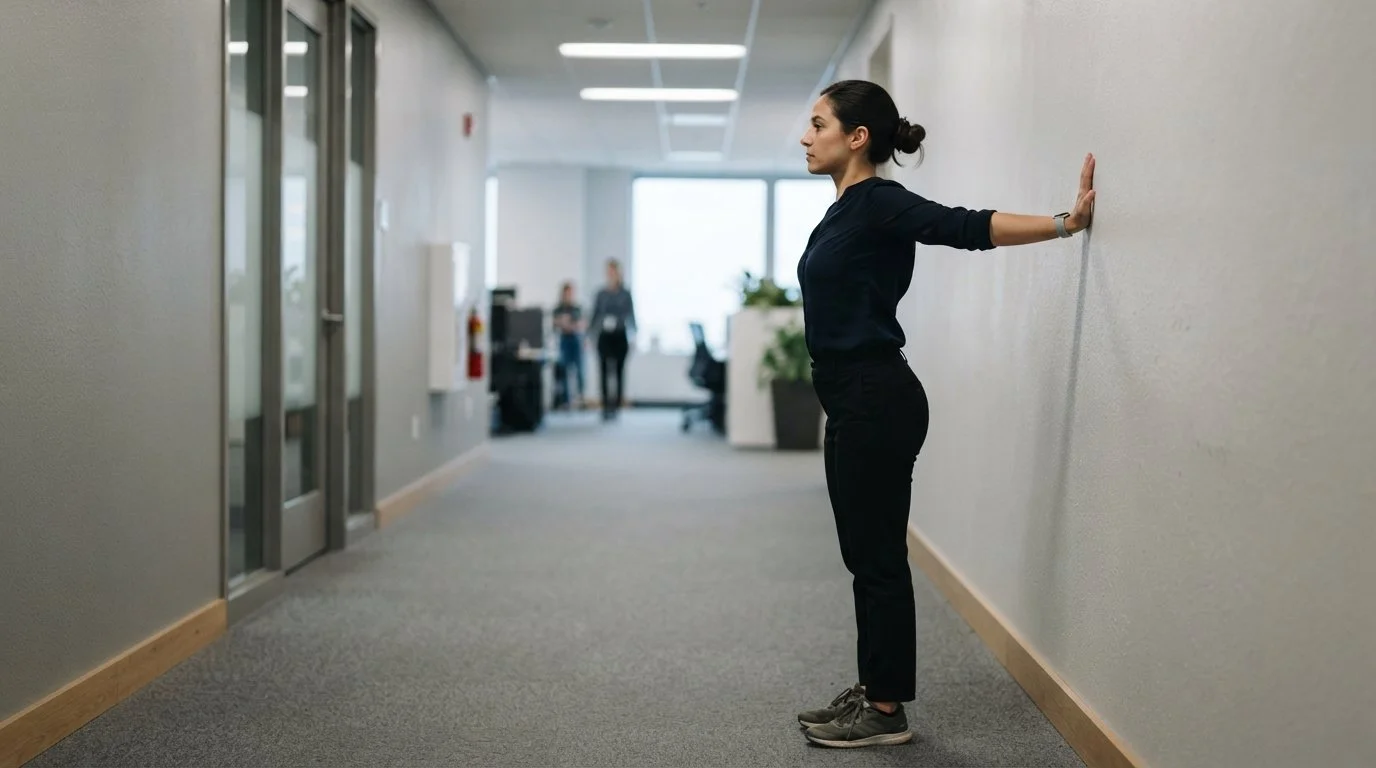
For a chest opener, bring your arms gently behind your body or rest your forearms on a doorway and step forwards a little. Use a smaller range if the front of your shoulders feels sensitive.
Slow shoulder rolls and gentle upper-back rotations add variety without needing a long break. Stop if a movement sharpens pain, causes symptoms to spread or leaves you feeling worse afterwards.
For teams who benefit from guided, adaptable movement, Mobility, Stretching, Self Massage and myofascial release is an injury-friendly prehab class featuring mobility, stretching, self-massage and myofascial release using balls. It suits this part of a routine because it brings several ways to move and release tension together in one class.
Add strengthening so the routine is more than stretching
Neck stretches can feel soothing, but they are not the whole routine. Pair comfortable mobility with exercises for the upper back and shoulder blades to build support around the neck and shoulders.
Try a shoulder-blade squeeze by drawing your shoulder blades slightly back and down, without shrugging or arching your lower back. Pause briefly, then release; the aim is controlled movement, not holding yourself in a tense position.
For wall slides, stand with your back near a wall and slide your arms upwards only as far as you can while keeping your shoulders relaxed. A smaller, smooth movement is more useful than pushing higher with a shrug.
Begin with a few controlled repetitions and build gradually. Prioritise easy, steady movement over effort, and reduce the range or repetitions if you feel strain.
Workplace Fitness classes offer teams sessions with instructors who accommodate different fitness levels and injuries. That flexibility suits a strengthening routine where people may need different ranges or ways to take part.

Attach micro-breaks to moments already in your workday
A movement routine is easier to repeat when it is attached to something that already happens. After finishing a call, sending a report or getting a drink, stand, take a brief walk, roll your shoulders or look into the distance for a moment.
Try this short sequence: stand and walk, do a few relaxed shoulder-blade squeezes, then choose one comfortable neck or chest movement before returning to work. You can keep the whole thing simple; this is a reset, not another item on your to-do list.
Vary sitting, standing and walking where you can. The aim is to move regularly, not to find one ideal posture and stay there.
One workplace study reported new neck pain in 17% of the active-break group and 17% of the postural-shift group, compared with 44% of the control group over the six-month follow-up. That is evidence from one study, not a guaranteed result for every worker.
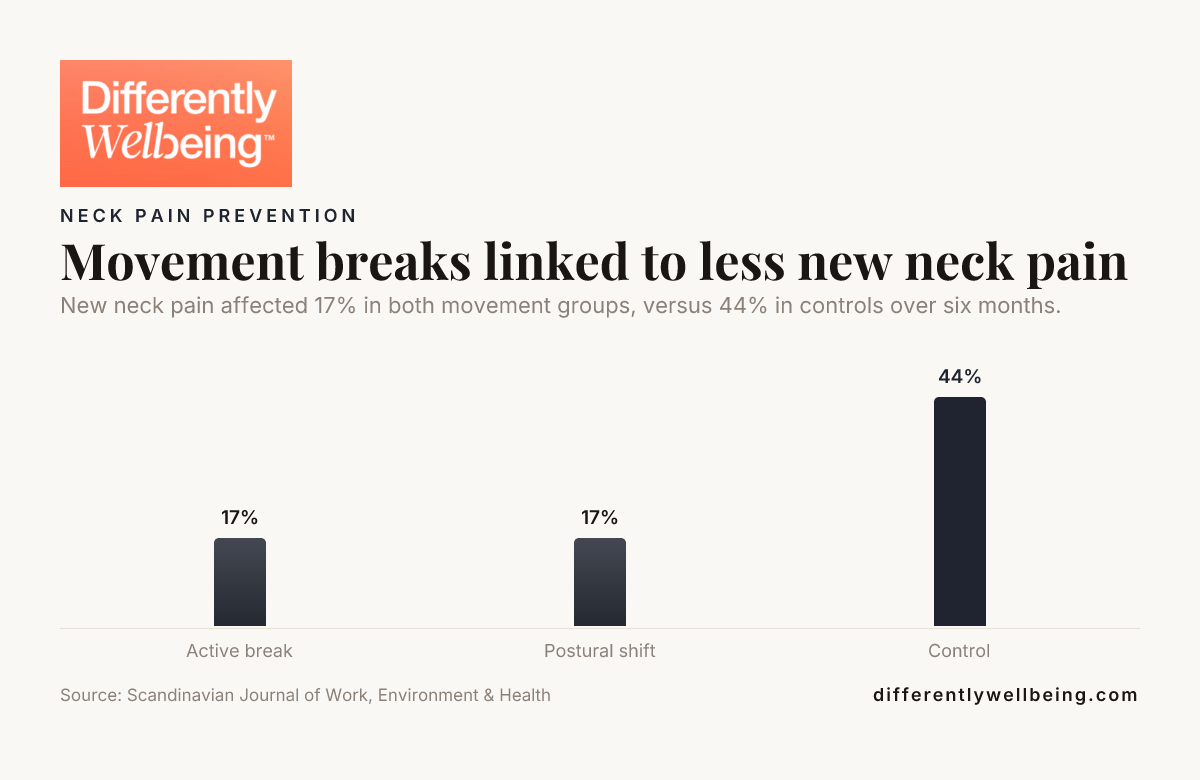
New neck pain affected 17% in both movement groups, versus 44% in controls over six months.
Source: Scandinavian Journal of Work, Environment & Health
Yoga & Desk Yoga is another corporate session option for bringing movement into a working day. A guided session can give a team time to pause together, while a few everyday micro-breaks help movement carry on between sessions.
Did You Know?
After adjusting for biopsychosocial factors, the hazard rate ratio for neck pain was HRadj 0.45 for the active break intervention.
Source: Scandinavian Journal of Work, Environment & Health
Adjust device habits and review what is helping
When you use a phone, bring it closer to eye level when comfortable and support your arms if needed. For prolonged phone viewing, the University of Miami News@TheU recommends frequent breaks every 10-20 minutes.
For laptop work, raising the screen works best alongside a separate keyboard and mouse. Without them, a higher display can create a new awkward position for your arms and shoulders.
Notice how each movement feels during and afterwards. A mild, temporary stretching sensation can be acceptable, but stop if pain increases, tingling or weakness appears, or symptoms feel worse later.
Track one simple measure for a week, such as end-of-day discomfort or how often you take movement breaks. If there is no improvement, symptoms worsen or your function is affected, seek tailored professional advice rather than trying to push through.
If your team needs support bringing guided movement into the workplace, our corporate yoga and wellbeing sessions include options for in-person, virtual and hybrid delivery. A session can complement the small habits you build into your own workday.

Comfortable Movement
How to combat 'Tech Neck' with targeted office movement is less about holding one flawless posture and more about making comfortable movement part of the day. Set your screen up well, combine gentle mobility with strengthening, and use natural workday transitions to change position.
Start small. Notice how you feel, adjust what aggravates symptoms and get individual guidance when discomfort persists or worsens. Little moments count, especially when your working day makes room for them.
Frequently Asked Questions
Can I do these desk movements without standing up?
Yes, several movements work while seated, including chin tucks, shoulder-blade squeezes and gentle upper-back rotations. Choose a stable chair and let the movement come from your upper body rather than rocking your whole torso.
How often should I take a movement break during a busy workday?
There is no single schedule that suits every role, so choose a rhythm you can maintain across focused tasks and meetings. A quiet timer or calendar reminder can help if your day tends to pass without a natural pause.
Should I use heat or ice for tech-neck discomfort?
A comfortably warm pack may feel soothing for tight muscles, while a cold pack wrapped in cloth may help numb a tender area. Protect your skin, keep either application comfortable, and seek professional advice if pain is severe or persistent.
Can tech neck cause headaches?
Neck tension can occur alongside headaches, including discomfort around the base of the skull, but headaches have many possible causes. A sudden, severe headache or one accompanied by other unusual symptoms needs prompt medical attention.
How long does it usually take for a movement routine to feel helpful?
There is no fixed timeline, and one session cannot tell you how a routine will work for you over time. Look for whether everyday screen tasks feel easier and whether you can move with less guarding, rather than judging progress by a single exercise.