
15-Minute 'Mental Fitness' Sprints: The Best Short-Form Wellbeing Habit for Busy People in 2026
15-Minute 'Mental Fitness' Sprints are one of the most powerful, accessible tools we have right now for building real psychological resilience, and the data backs it up: 15 minutes of daily movement and intentional mental practice improves a person's mental state by 22.5% and increases overall mental health scores by 14 points. In a world where corporate wellbeing is finally being taken seriously, this tiny habit is quietly outperforming programmes that cost ten times as much.

Key Takeaways
What is a 15-Minute Mental Fitness Sprint?
A structured, short-form wellbeing practice (15 minutes or less) designed to sharpen focus, reduce stress, and build mental resilience in the gaps of a busy day.
Are 15-minute mental fitness sessions actually effective?
Yes. Research in 2026 consistently shows that shorter, more frequent sessions outperform longer, irregular ones for stress reduction, focus, and mood.
What formats work best for mental fitness sprints?
Breathwork, desk yoga, guided meditation, mindful movement, and focused journaling are all proven sprint formats. See our sprints page for our current offerings.
Can mental fitness sprints work in a corporate setting?
Absolutely. They are one of the lowest-barrier, highest-impact corporate wellness interventions available today, requiring no equipment and no gym.
How often should you do a mental fitness sprint?
Daily is ideal. Even 3 to 5 times per week produces measurable improvements in mood, focus, and stress tolerance.
Who are mental fitness sprints best for?
Anyone with a busy schedule, high-stress role, or a previous track record of abandoning longer wellness routines. That's most of us.
Do I need any experience to start?
Zero. That's the whole point. Our beginner's guide to meditation is a great first step if you're new to any of this.
What Are 15-Minute 'Mental Fitness' Sprints, and Why Should You Care?
Let's be real. Most people don't have an hour to dedicate to a yoga class on a Tuesday afternoon. They have a back-to-back calendar, a lukewarm coffee, and exactly 15 minutes between calls.
That's where 15-Minute 'Mental Fitness' Sprints come in. A mental fitness sprint is a short, intentional burst of wellbeing activity designed to do one specific thing: give your brain a genuine reset.
Unlike a passive scroll or a caffeine hit, a properly designed sprint actively strengthens your cognitive and emotional resilience. Think of it like interval training, but for your mind.
The best part? You don't need a studio, a mat, a membership, or even silence. You need 15 minutes and the right framework. That's it.
Best for Busy Professionals: Why 15-Minute Mental Fitness Sprints Beat Longer Routines
Here's something the wellness industry doesn't always want to admit: longer isn't always better. The assumption that real mental health work requires a 60-minute commitment is one of the biggest barriers to people actually doing anything at all.
We see this constantly in our stress talks and workshops. The number one reason people cite for not looking after their mental health is time. Not motivation. Not money. Time.
15-Minute 'Mental Fitness' Sprints dismantle that barrier completely. They are specifically designed for the person who thinks they "don't have time" for wellbeing. Because they do. Everyone does.
No commute needed. A sprint happens at your desk, in a meeting room, or on a bench outside.
No kit required. Breathwork, meditation, and body-scan exercises need nothing but you.
No experience necessary. These sprints are built for real people, not wellness veterans.
No guilt about stopping. You're done in 15 minutes. That's the deal.
For professionals in fast-paced environments, consistency beats duration every single time.
The Science Behind 15-Minute Mental Fitness Sprints
We're not asking you to take this on faith. The research in 2026 is genuinely compelling.
Studies show that after only 2 hours of continuous desk work, mental-health scores begin to decline, with stress levels rising by 18% after 4 hours of unbroken work. That's the window that mental fitness sprints are designed to interrupt.
Research also confirms that 11 to 20 minute meditation sessions are associated with the highest gains in resilience for beginners, outperforming longer 30-minute sessions. So if you're just starting out, shorter is actually smarter.
And then there's the depression data. Just 10 to 15 minutes of daily intentional movement can lower the risk of depression by 18%. That is not a small number. That's the kind of result that changes lives.
Did You Know?
Taking a 15-minute 'desk break' every day for one week increases productivity by 33.2% and focus by 28.6%.
Source: Women's Health Magazine
The biological mechanism here is important to understand. A single 15-minute aerobic sprint creates an optimal brain state for long-term memory consolidation and efficient neural resource allocation. In plain English: it makes you sharper, faster, and better at complex thinking.
This isn't a wellness trend. It's physiology.

Best for Corporate Wellbeing: Embedding Mental Fitness Sprints Into the Working Day
Corporate wellbeing programmes have had a trust problem for years. Employees have seen the fruit bowls. They've endured the mandatory mindfulness emails. They know the difference between box-ticking and something that genuinely helps.
15-Minute 'Mental Fitness' Sprints are the antidote to all of that. They are fast, practical, and impossible to dismiss as "fluffy."
When we work with organisations on their wellbeing programmes, one of the first things we recommend is building sprint slots directly into the working calendar. Not optional. Not "encouraged." Built in, normalised, and led from the top.
Here's what that looks like in practice:
A 15-minute breathwork session before the all-hands meeting on Monday.
A mid-afternoon desk yoga break on Wednesday to combat the post-lunch slump.
A Friday wind-down meditation to close the week with intention rather than frantic email-checking.
None of these require a facilitator to be on-site every day. But having expert-led sessions regularly, as part of a structured corporate wellness programme, is what turns a good habit into a cultural shift.
Our evidence-based corporate wellness programmes are built around exactly this kind of structured, repeatable approach.
The 6 Best 15-Minute Mental Fitness Sprint Formats
Not all sprints are created equal. The best format for you depends on what your brain needs at that specific moment in the day.
Here's our honest breakdown of the most effective sprint types:
Breathwork Sprints
Best for: Acute stress, anxiety spikes, pre-meeting nerves.
Our breathwork sessions use evidence-based techniques to shift your nervous system from fight-or-flight to focused calm in under 15 minutes.Desk Yoga Sprints
Best for: Physical tension from long sitting periods, post-commute stiffness, energy dips.
Our desk yoga sessions require no mat and no floor space. Chair-based, judgment-free, and genuinely effective.Guided Meditation Sprints
Best for: Racing thoughts, decision fatigue, chronic overwhelm.
Even 10 to 15 minutes of guided practice reduces clinical anxiety symptoms measurably. Our meditation sessions are designed for people who "can't meditate."Mindful Movement Sprints
Best for: Low mood, afternoon slumps, creative blocks.
A short walk with intentional focus counts. So does a gentle pilates flow or a structured stretch sequence.Focused Journaling Sprints
Best for: Processing a difficult interaction, setting intention, clearing mental clutter before a big task.
Three prompts. 15 minutes. Surprisingly powerful.Sound-Based Sprints
Best for: Deep reset during high-pressure periods, nervous system regulation at the end of a hard day.
Our immersive headphone meditations deliver a genuinely restorative experience in a sprint-friendly format.
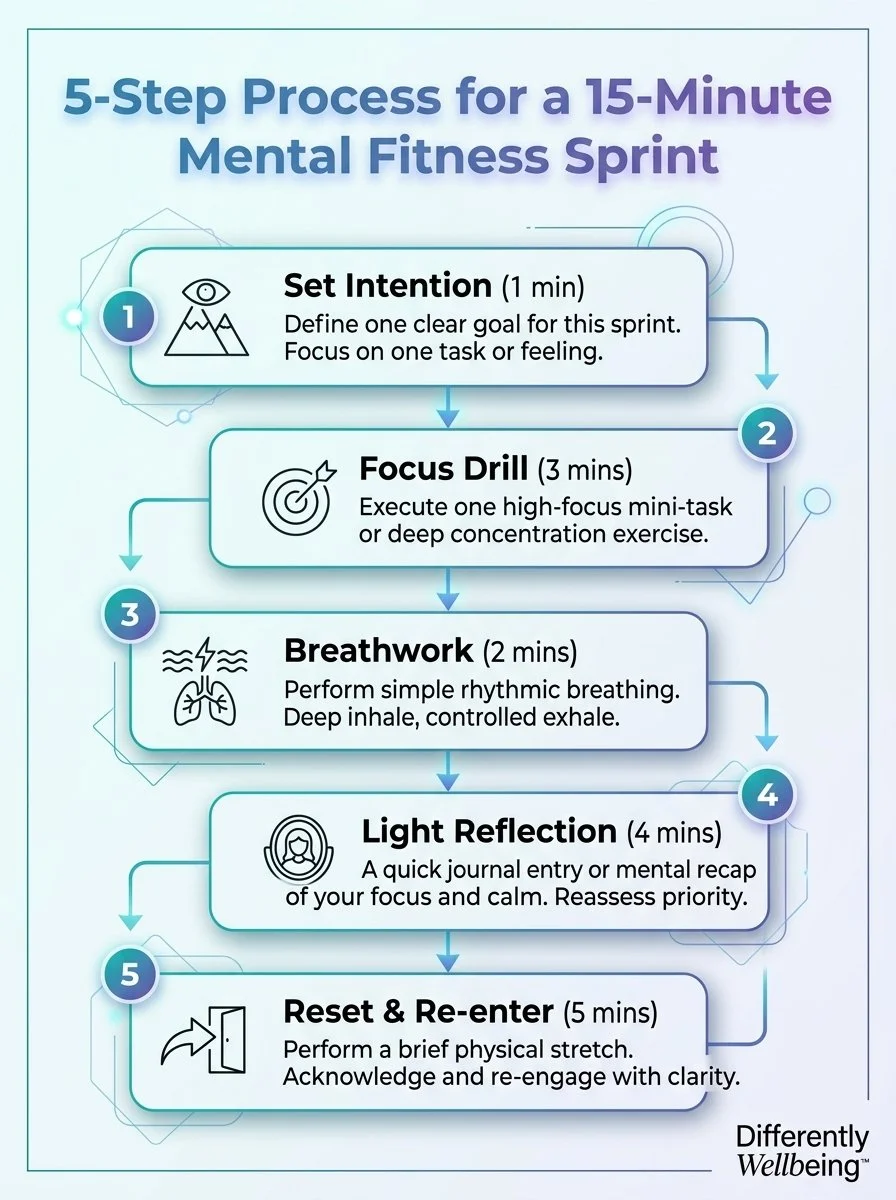
A concise, 5-step guide to a 15-minute mental fitness sprint. Use this quick framework to boost focus and resilience in just 15 minutes.

Best for Teams: Running 15-Minute Mental Fitness Sprints as Corporate Wellness Sessions
Corporate wellness doesn't have to mean an away day and a ropes course. Some of the most impactful team wellbeing moments we've facilitated have been 15-minute group mental fitness sprints squeezed between a weekly stand-up and a client call.
Team-based sprints add a layer of accountability and social connection that solo practice can't replicate. When your colleagues see you taking 15 minutes to breathe, to move, to reset, it normalises the behaviour for everyone.
73% of users report that the mental health benefits of 15-minute daily movement sessions last longer than those gained from a full wellness holiday. Let that land for a second. Fifteen minutes a day, done consistently, beats a week in a spa for long-term mental health gains.
For teams, the most effective sprint formats are:
Group breathwork to open or close a team meeting with presence.
A shared desk yoga sequence during a mid-morning break.
A facilitated group reflection at the end of a demanding project sprint.
Our mental health and workplace culture talks can help you understand how to build these rituals into your team's rhythm without it feeling forced or awkward.
How to Build a Daily 15-Minute Mental Fitness Sprint Habit That Sticks
Here's the uncomfortable truth: most wellbeing habits fail not because people don't want to do them, but because they don't have a clear trigger, a clear format, and a clear end point.
Mental fitness sprints solve all three of those problems by design. But you still need to be intentional about embedding them.
Here's the framework we recommend:
Anchor your sprint to an existing habit. Right after your first coffee. Right before lunch. Right when you close your laptop. Attach the sprint to something you already do every day.
Choose your format in advance. Decision fatigue is real. Know on Monday which sprint you're doing on Thursday. Remove the choice from the moment.
Set a hard stop. The 15-minute limit is not a suggestion. It's what makes the habit sustainable. When the timer ends, you're done.
Track it simply. Not a full wellness journal. Just a tick in your calendar. Done is done.
Mix the formats. Variety prevents boredom and ensures you're training different aspects of mental fitness across the week.
"Consistency over intensity. A 15-minute mental fitness sprint done daily is worth ten times more than a two-hour session done once a fortnight."
Did You Know?
92% of employees who participate in structured 15-minute mental fitness programs recommend them to their peers, indicating high user satisfaction.
Source: News-Medical.Net
Best for Stress and Burnout: Choosing the Right 15-Minute Mental Fitness Sprint
Not every day looks the same. And not every mental fitness sprint should, either. The key is matching your sprint to your actual mental state in that moment, not just picking your favourite format on autopilot.
Here's a quick reference guide:
HOW YOU'RE FEELING |
BEST SPRINT FORMAT |
WHY IT WORKS |
|---|---|---|
Anxious or overwhelmed |
Breathwork sprint |
Directly regulates the nervous system via the vagus nerve |
Physically tense and restless |
Desk yoga or mindful movement |
Releases stored physical tension that amplifies stress signals |
Mentally foggy or unfocused |
Guided meditation sprint |
Trains attention and clears cognitive clutter |
Emotionally drained or flat |
Sound-based sprint |
Passive restoration, no cognitive effort required |
Spinning thoughts before sleep |
Journaling sprint |
Externalises mental loops so the brain can let go |
Low energy mid-afternoon |
Mindful movement sprint |
Boosts circulation and reactivates the brain's alert systems |
When mental fitness sprints are built into a broader corporate wellbeing strategy, this kind of personalised matching becomes second nature. Teams start to recognise what they need, when they need it, and they have the tools to act on it immediately.
Common Mistakes People Make with 15-Minute Mental Fitness Sprints
We've run enough sessions to know the pitfalls. Here's what gets in the way, and how to sidestep it.
Treating it as a reward rather than a routine. A sprint isn't something you do when you've "earned" a break. It's a non-negotiable part of a healthy working day.
Expecting instant transformation. A single sprint will improve your state in that moment. A consistent habit changes your baseline over time. Give it two weeks before you judge it.
Choosing the most comfortable format every time. If you always default to the easiest sprint, you're not building new mental fitness. You're just maintaining what you already have. Rotate the challenge.
Doing it on your phone while checking messages. Half an eye on Slack is not a sprint. It's a distracted break. Full presence for 15 minutes. That's the deal.
Going it alone when you don't have to. Group-based sprints, whether through a corporate wellness provider or with a small team of colleagues, significantly increase adherence and enjoyment.
If your organisation is trying to build a genuine corporate wellbeing culture rather than just ticking a box, getting expert support for your sprint programme is one of the smartest investments you can make. Our full range of wellbeing services is built for exactly that.

Best for Getting Started: How Differently Wellbeing Can Help
We're not here to sell you a 12-week programme you'll abandon by week three. We're here to give your team tools that actually work in the real world, on real schedules, with real budgets.
Our approach to mental fitness sprints is practical, inclusive, and (yes, we'll say it) a little bit fun. We bring the expertise, the energy, and the framework. Your team brings the 15 minutes.
Whether you want a one-off taster session or a fully embedded corporate wellbeing programme with regular sprint sessions built into the working calendar, we can make it happen.
Some of our most popular sprint-compatible services include:
Breathwork sessions for fast, evidence-based stress relief.
Guided meditation designed for beginners and sceptics alike.
Desk yoga that fits into any office environment with zero kit required.
Sound adventures for deep, restorative neural reset in a short time frame.
Nutrition workshops to complement the cognitive benefits of your sprint practice.
No fluff. No fuss. Just real results that your team will actually talk about on the way back to their desks.
Ready to give it a go?
15-Minute 'Mental Fitness' Sprints are not a trend. They are not a corporate wellness checkbox. They are one of the most evidence-backed, time-efficient, and genuinely accessible tools available for building a healthier, more resilient workforce in 2026.
The science is clear. The results are real. And the barrier to entry is just 15 minutes.
Whether you're an individual trying to build a sustainable mental fitness habit, or an organisation looking to create a corporate wellbeing culture that people actually value, mental fitness sprints are where we'd tell you to start.
We're Differently Wellbeing. We do things differently. And we'd love to help you build a sprint practice that actually sticks. Take a look at what we offer at differentlywellbeing.com and let's get started.