
Effective Breathwork Exercises to Stop a Workplace Panic Attack (And Actually Get Through Your Day)
Knowing the most effective breathwork exercises to stop a workplace panic attack could genuinely change someone's working day, because 28% of workers report having had an anxiety or panic attack — meaning in any room of ten people, there's a good chance two or three of them know exactly what we're talking about. That racing heart, the tunnel vision, the overwhelming urge to escape the building? It's more common than most offices ever acknowledge, and it deserves a proper, practical answer.
Key Takeaways
Question |
Answer |
|---|---|
What is the fastest breathwork exercise for a workplace panic attack? |
Box breathing (4 counts in, hold, out, hold) is one of the fastest techniques to activate the parasympathetic nervous system and interrupt a panic response. |
Can breathwork really stop a panic attack? |
Yes. Controlled breathing directly targets the nervous system, slowing heart rate and reducing the physical symptoms of panic. It won't eliminate the root cause, but it reliably reduces acute symptoms. |
Do I need to leave my desk to do breathwork? |
Not at all. Every technique in this guide can be done seated at your desk, no mat, no equipment, and no one around you will notice. |
How does corporate wellbeing support panic management? |
A strong corporate wellbeing programme gives employees both the tools and the regular practice to manage anxiety before it escalates. |
What breathing rate is most effective for anxiety? |
Research points to approximately 4.5 to 6.5 breaths per minute as a "resonance" range that measurably supports anxiety regulation in adults. |
Is breathwork the same as meditation? |
They overlap but they're different. Breathwork is an active, breath-led technique. Meditation is broader. Both sit within a good corporate breathwork and mindfulness programme. |
Can teams learn breathwork together? |
Absolutely, and it sticks better when practised as a group. Expert-led team sessions are one of the most practical ways to build these skills across a workforce. |
The Science Behind Effective Breathwork Exercises to Stop a Workplace Panic Attack
We're not going to give you a TED Talk here, but you do deserve to know this isn't just wellness fluff. There is real, peer-reviewed evidence behind breathwork as a panic intervention.
Techniques like box breathing, coherent breathing, and diaphragmatic breathing all work by directly influencing the vagus nerve, which acts as the main brake pedal on your stress response. When you extend the exhale or slow your breath to a controlled pace, you are literally applying that brake.
The good news for corporate wellness decision-makers: this isn't speculative. It's backed by growing meta-analysis evidence, and it's teachable to entire teams in a single session.
Did You Know?
A meta-analysis of randomised controlled trials found that breathwork had measurable, statistically significant effects on stress and mental health outcomes including anxiety — not just in clinical settings, but in everyday participants.
Source: Scientific Reports (Nature)
The Best Breathwork Exercises to Stop a Workplace Panic Attack (Ranked by Use Case)
Here's the practical bit. These are the exercises that actually work, explained in plain English, with no pretentiousness and no fancy equipment required.
Best for Immediate Calm: Box Breathing
Box breathing (also called square breathing) is the technique used by Navy SEALs and, dare we say it, some of the world's top CEOs to reset under extreme pressure. If it works in combat, it'll work in a Tuesday morning meeting.
How to do it:
Inhale through your nose for 4 counts
Hold your breath for 4 counts
Exhale through your mouth for 4 counts
Hold for 4 counts
Repeat for 4 to 6 cycles
You can do this at your desk. Eyes open or closed. No one will know.
Best for Intense Anxiety: 4-7-8 Breathing
This technique, popularised by Dr Andrew Weil, is particularly powerful because the long exhale aggressively stimulates the parasympathetic nervous system. It's one of the most effective breathwork exercises to stop a workplace panic attack when the symptoms feel intense.
How to do it:
Inhale quietly through your nose for 4 counts
Hold for 7 counts
Exhale completely through your mouth for 8 counts
Repeat up to 4 cycles
The extended exhale is the key. It's doing most of the heavy lifting on your nervous system.
Best for Beginners: Diaphragmatic (Belly) Breathing
During a panic attack, most people breathe from their chest, which is shallow, rapid, and makes things worse. Diaphragmatic breathing shifts that pattern fast.
How to do it:
Place one hand flat on your stomach, just below your ribcage
Breathe in slowly through your nose, feeling your stomach push outward (not your chest)
Exhale slowly through pursed lips, letting your stomach fall
Aim for a breath every 4 to 6 seconds
Research on controlled diaphragmatic breathing consistently supports its effectiveness in reducing state anxiety. It's also the most discreet option on this list.

Best for Ongoing Stress (Not Just Acute Panic): Coherent Breathing
Coherent breathing (also called resonance breathing) targets the specific heart rate variability sweet spot that researchers associate with optimal stress regulation. It's the slow, steady approach that builds resilience over time, making it a brilliant addition to any corporate wellness programme.
How to do it:
Inhale for 5 to 6 counts
Exhale for 5 to 6 counts
Maintain this rhythm for 5 to 10 minutes
No holding, just smooth, even breathing
This brings you to approximately 5 to 6 breaths per minute, which sits right inside the research-supported "resonance range" associated with anxiety regulation. It's not exciting. It works.
Best for a Quick Reset Between Meetings: Extended Exhale Breathing
Short on time? This is your go-to. The principle is simple: make your exhale longer than your inhale. That's it. That's the whole technique.
How to do it:
Inhale for 4 counts
Exhale for 6 to 8 counts
Repeat for 2 to 3 minutes
This is the one we'd recommend for someone who catches the early warning signs of a panic attack before it fully escalates. It can be done mid-email. No one needs to know.
How to Actually Use These Breathwork Exercises at Your Desk
Knowing the techniques is step one. Using them under pressure is step two, and that takes a bit of preparation. Here's how to set yourself up for success.
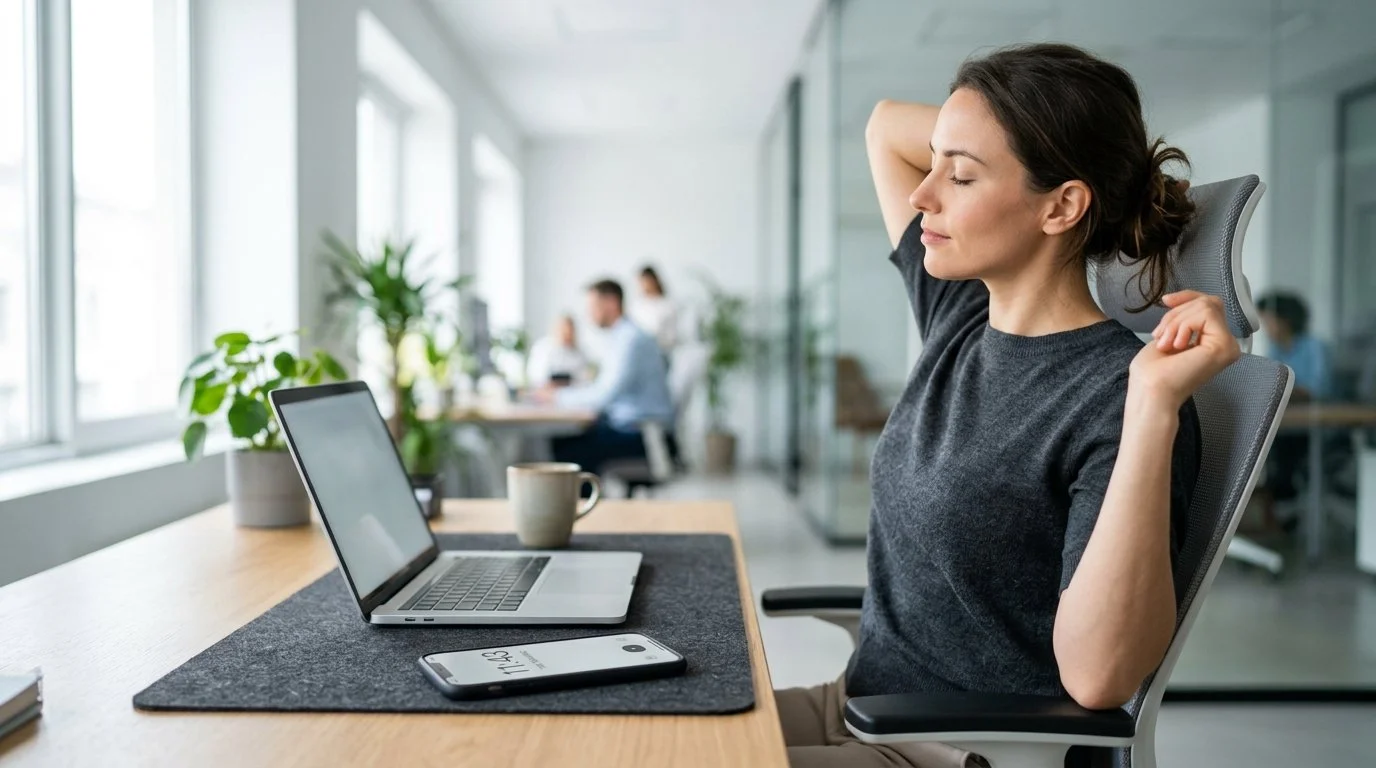
Anchor it to something physical. Putting your feet flat on the floor, sitting back in your chair, or placing a hand on your stomach gives your nervous system a physical signal that you are safe and grounded.
Have a "first move" decided in advance. In a panic, you will not remember which exercise to pick. Choose one technique as your default and make it automatic through regular practice.
Use a timer. On your phone, as a browser extension, anything. Counting seconds while panicking is genuinely difficult. A timer removes that cognitive load entirely.
Don't try to breathe through a full panic at your screen. If you can step away from your monitor for 90 seconds, do. You'll return more functional than if you white-knuckle it at your desk.
If you're a manager reading this, please pin this to a shared resource. Effective breathwork exercises to stop a workplace panic attack are only useful if people know about them before they need them.

Corporate Wellbeing: Why Individual Breathwork Tools Are Not Enough on Their Own
Here's the honest bit: giving someone a breathwork cheat sheet is helpful. Embedding breathwork practice into your corporate wellbeing culture is transformative.
The difference is repetition. A breathing technique learned once in a stressful moment will often be forgotten in the next stressful moment. A breathing technique practised regularly, ideally with expert guidance, becomes an automatic response. That is the goal.
In 2026, more organisations are recognising that reactive mental health support (the employee assistance programme that nobody uses, the leaflet in the kitchen) is not the same as proactive corporate wellness strategy. And we're not having it when it comes to wellness fluff that looks good in a board report but does nothing in the real world.
Did You Know?
Slow breathing in the approximate "resonance" range of 4.5 to 6.5 breaths per minute is associated with measurable anxiety-regulation effects in adult research — making this a precise, evidence-based target for workplace breathwork sessions, not just a rough guess.
Source: Scientific Reports (Nature), 2025
How We Bring Effective Breathwork Exercises to Stop a Workplace Panic Attack Into Teams
We're a small, female-founded, conscious agency of London's top wellbeing coaches and instructors, and we've been doing this for over 6 years. We've left thousands of people with genuinely useful skills, not just a nice hour out of the office.
Our corporate breathwork, mindfulness, and meditation sessions use the same techniques that CEOs and Navy SEALs use, including the box breathing and coherent breathing techniques covered in this article. We bring them to your team in a format that's actually engaging.
No lectures. No jargon. No pretentiousness. Just practical tools that stick.
We deliver sessions:
In-office (including in your boardroom, on chairs, with zero yoga mats needed)
Virtually (for remote and hybrid teams)
At away days and conferences, as energisers or closing sessions
As part of a bespoke, year-round wellbeing programme
And our pricing is a flat fee from 1 to 50 people, so there's no awkward "per head" calculation every time you want to run a session.
If you're a leader or manager who genuinely gives a damn about your team's mental health, and you want breathwork to be more than a poster in the break room, let's talk about what we can build for you.
Beyond Breathwork: Building a Panic-Resilient Workplace Culture
Breathwork is one powerful pillar. But panic in the workplace doesn't exist in isolation. It sits alongside stress load, sleep quality, financial pressure, workload, and team culture. A comprehensive corporate wellbeing approach addresses all of it.
Alongside breathwork sessions, we'd point you towards:
Mental health and financial wellbeing workshops, which tackle the root-cause stressors that often trigger panic
Desk yoga and chair-based movement, which regulate the nervous system through the body as well as the breath
Our breathe and thrive guide, which goes deeper into how breathwork fits into a sustainable wellbeing routine
15-minute mental fitness sprints for building quick, daily mental health habits at team level
The goal is a workplace where people have the skills to manage anxiety before it becomes a panic attack — and the psychological safety to not feel ashamed when it does.
Most Effective Exercises
The most effective breathwork exercises to stop a workplace panic attack are not complicated. Box breathing, 4-7-8, diaphragmatic breathing, coherent breathing, and the extended exhale are all accessible, desk-friendly, and backed by real evidence. The barrier isn't knowledge — it's practice.
In 2026, where workplace anxiety is increasingly visible and the expectations on employees are higher than ever, giving your team these tools isn't a nice-to-have. It's a basic part of a responsible corporate wellness strategy.
If you want those tools embedded properly, with expert-led sessions that don't waste anyone's time, we're here for it. No fluff. No fuss. Just real results. Explore our full corporate wellness session options or hear what thousands of people are saying about what we do.
Frequently Asked Questions.
What is the best breathwork exercise to stop a panic attack at work right now?
Box breathing is generally considered the fastest and most accessible option: inhale for 4 counts, hold for 4, exhale for 4, hold for 4. Repeat 4 to 6 times. It can be done silently at your desk and typically produces noticeable calm within 2 to 3 minutes of use.
How long does breathwork take to stop a workplace panic attack?
Most people notice a measurable reduction in symptoms within 2 to 5 minutes of consistent, controlled breathwork. Effective breathwork exercises to stop a workplace panic attack work by directly activating the parasympathetic nervous system, and the nervous system responds relatively quickly to breathing changes.
Can breathing exercises actually stop a panic attack or just distract from it?
Breathwork does more than distract — it physiologically interrupts the panic cycle by lowering heart rate and reducing the stress hormone cascade. Meta-analyses of randomised controlled trials confirm breathwork has measurable effects on anxiety, not just perceived comfort.
Is it weird to do breathwork exercises at your desk in front of colleagues?
Not at all, and honestly, more workplaces should normalise it. All of the techniques in this guide are completely invisible to others, involving no unusual postures or sounds. If your workplace culture makes someone feel uncomfortable breathing intentionally, that's a corporate wellbeing conversation worth having.
How can companies make breathwork part of corporate wellness in 2026?
The most effective approach is regular, expert-led sessions where the whole team practises together — building the skill before it's urgently needed. In 2026, the best corporate wellness programmes combine breathwork with mindfulness, movement, and mental health education to create a genuinely resilient workforce culture.
What is the difference between breathwork and meditation for panic attacks?
Breathwork is an active, breath-led intervention that directly manipulates your nervous system state — it's particularly effective during acute panic. Meditation is broader and often more passive, building resilience over time. Both are valuable tools in a complete corporate wellbeing strategy, and our expert-led sessions cover both.
Are breathwork sessions worth it for teams, or can people just look up techniques themselves?
People can absolutely look up techniques, and we encourage it. But practised skills outperform looked-up knowledge every time under pressure, and that's what expert-led corporate wellbeing sessions provide: real practice, with coaching, in a group setting that builds accountability and habit far more effectively than a solo YouTube search at 11pm.